











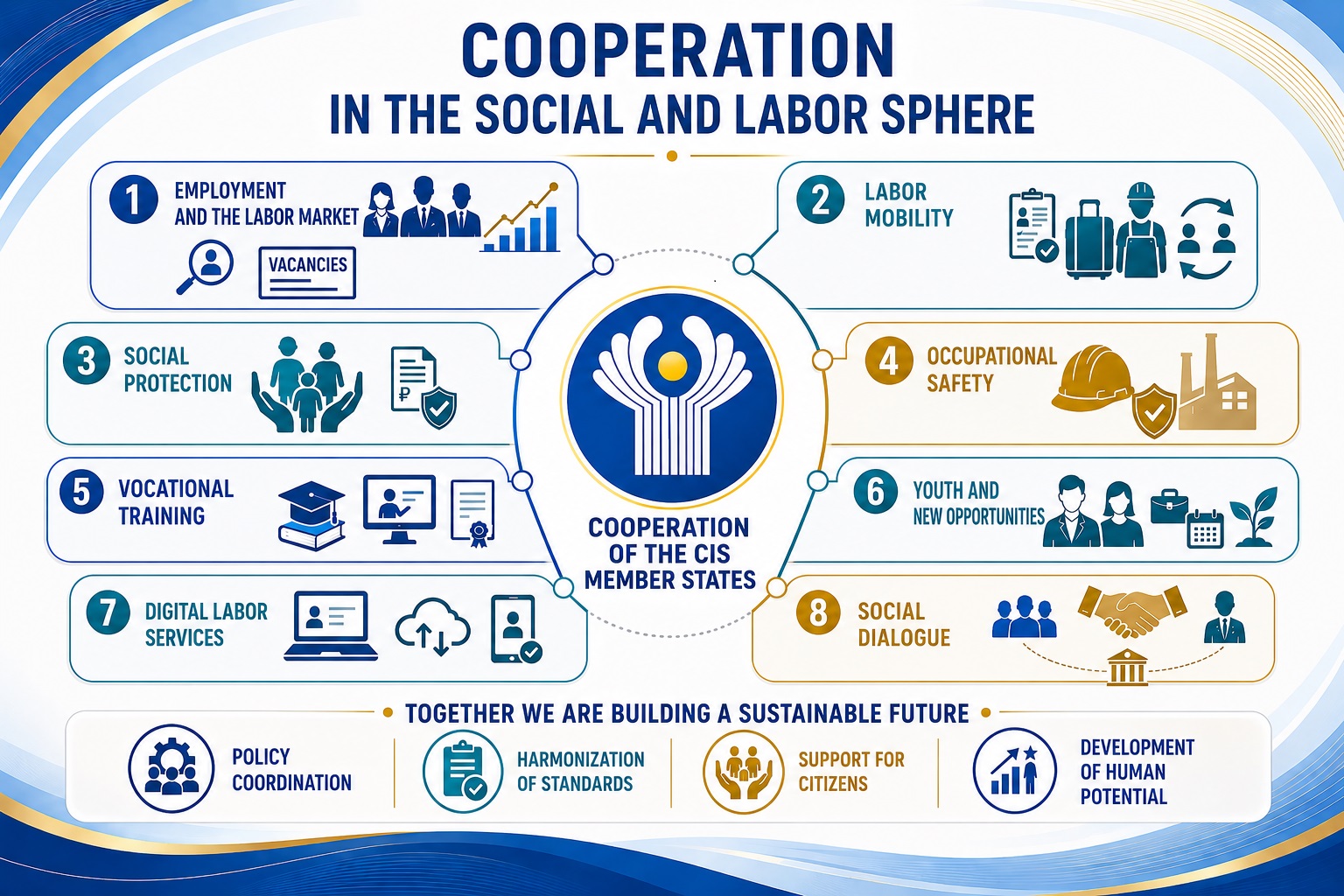
The cooperation in the social and labour sphere is one of the priority areas of activity of the Commonwealth of Independent States.
The leading role in jointly developing mechanisms for interstate cooperation is played by the Advisory Council on Labour, Employment and Social Protection of the Population of the CIS States (in Russian), established in November 1992.
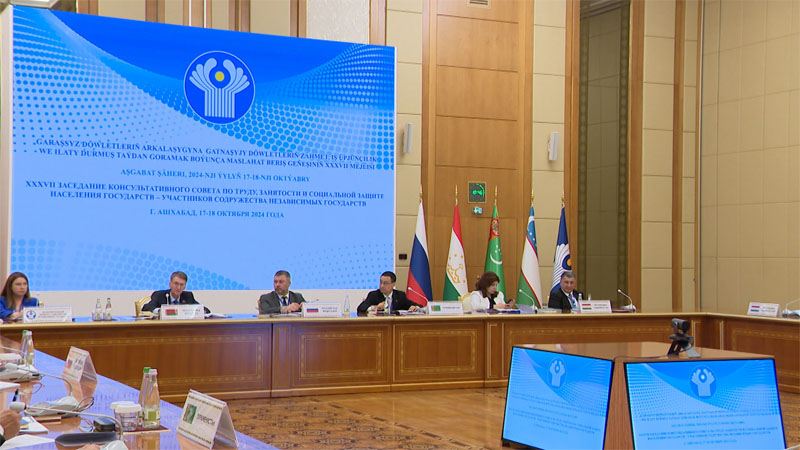
37th meeting of the Advisory Council on Labor, Employment, and Social Protection of the Population of the CIS Member States.
Ashgabat, October 19, 2024.
The formation of this sectoral body was an important step towards deepening the cooperation among the Commonwealth countries in one of the most sensitive areas. The Council has become a mechanism for the continuous exchange of views between the heads of relevant agencies of the CIS countries — those who directly shape the policy in the areas of labour, employment and social protection.
They discuss common challenges in detail and find mutually acceptable solutions. Through the work of the Council, practical issues that are difficult to resolve on a bilateral basis are addressed.
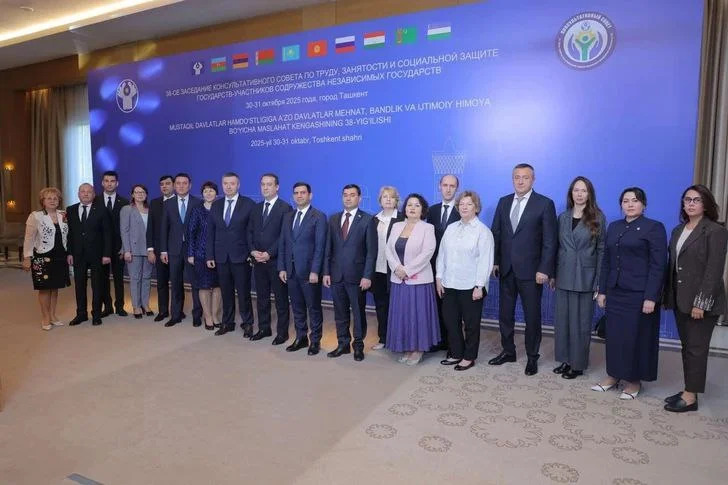
38th meeting of the Consultative Council on Labor, Employment, and Social Protection of the Population of the CIS Member States.
Tashkent, November 4, 2025.
The issue of labour standardization is one of the cornerstones. The strategic framework for the systematic cooperation among the Commonwealth countries in this area was laid by the approval of the Conceptual Framework (in Russian) in 2011, and corresponding plans are developed every five years to implement it.
On June 26, 2026, the Plan of Key Activities for the Implementation of the Conceptual Framework for Cooperation among the CIS Member States in the Field of Labour Standardization for 2026–2030 (in Russian) was approved at a meeting of the CIS Economic Council in Moscow. The adoption of this document will contribute to further progress towards the goals formulated in 2011: improving labour productivity and the competitiveness of the Commonwealth countries economies through the improvement of standardization systems. At the same time, it envisages the development of national IT technologies in this area, the improvement of information exchange regarding the procedure for organizing labor standardization, the updating of labor standards, the provision of materials for labor standardization to economic entities, the training and professional development of personnel from the CIS member states, as well as the conduct of relevant joint research.
Another key document regulating the cooperation among the Commonwealth countries in the social and labour sphere is the Concept for the Gradual Formation of a Common Labour Market and Regulation of Migration in the CIS Member States, an updated version (in Russian) of which was adopted in 2024. According to this document, it is planned to intensify the joint implementation of measures aimed at the reproduction, regulation, exchange, and rational use of the workforce in the CIS member states, with a view to increasing the efficiency of using the combined labour and intellectual potential. These measures are formulated in a concentrated form in the already agreed draft of the relevant comprehensive programme. Its approval should lead to the creation of qualitatively new conditions for the free movement of the workforce.
At present the development of a new version on the Concept of the Common Migration Space of the CIS member states is in its final stage (the current version (in Russian) was adopted in 2012). The adoption of the updated concept, scheduled for the second half of 2026, will contribute to the formation of unified approaches to streamlining legal migration. It will reflect a unified understanding of the regulation of migration processes in the Commonwealth, which will help to develop legal migration and more effectively combat its illegal component.