








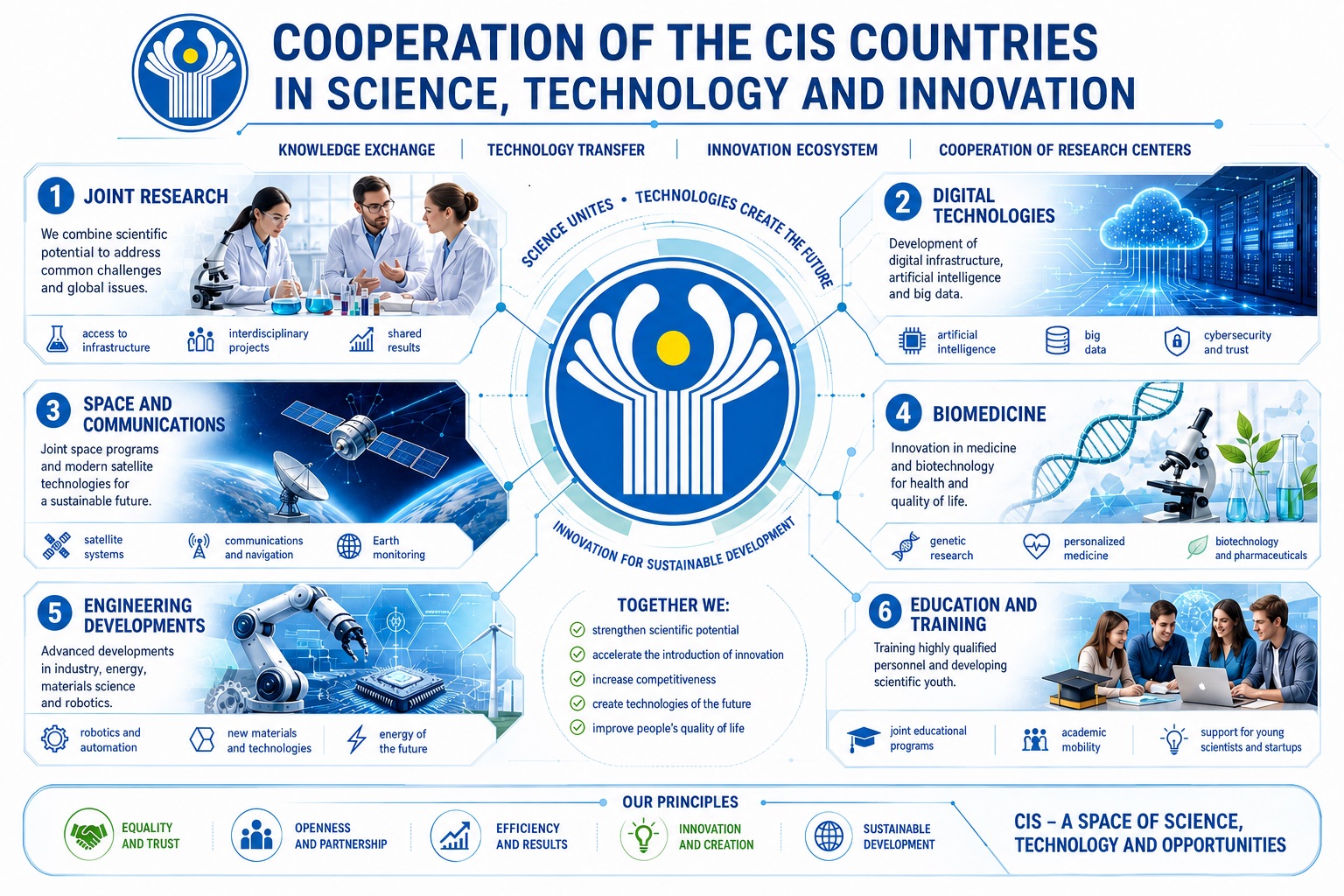
The announcement of a strategic course for scientific and technological development confirms the priority of close cooperation among the CIS member states in this field. The fundamental basis for this cooperation is the Strategy for Scientific and Technological Development of the Commonwealth for 2026–2035, approved by the Decision of the Council of Heads of Governments of the Commonwealth of Independent States in September 2025. The document defines the goals, objectives, and priorities of cooperation aimed at strengthening scientific and technological sovereignty, sustainable socio-economic development, and enhancing the competitiveness of national economies.
Over the past 35 years, a multi-level system of cooperation in the scientific, technical, and innovative spheres has been formed across the CIS, encompassing program-target and institutional mechanisms.
The Interstate Council for Cooperation in the Scientific, Technical, and Innovative Spheres (IC STIS) plays a leading role in implementing integration plans and projects, serving as the key sectoral body for coordinating cooperation. In the field of fundamental science, the specialized Council for Cooperation in the Field of Fundamental Science operates.
On April 28, 2026, in Moscow the 37th meeting of the Interstate Council for Cooperation in the Scientific, Technical, and Innovative Spheres (IC STIS) was held in a hybrid format. In addition to discussing the action plan for implementing the Strategy, its agenda included two important initiatives: Kazakhstan’s proposal to establish the CIS Alliance of IT Startup Technoparks and Uzbekistan’s proposal to develop a concept for a venture platform to foster startups. These steps are aimed at providing practical support for innovative projects and creating a favorable environment for technological entrepreneurship across the Commonwealth.

A number of working groups and specialized structures operate on issues of fundamental research, innovation policy, human resource development, and information exchange, coordinating joint scientific projects, sharing advanced developments, and strengthening cooperation in the interests of technological development across the Commonwealth.
In this area of cooperation, 2 research centers and 22 higher education institutions of the Commonwealth countries currently hold the status of CIS base organizations, specializing in a wide range of fields—from fundamental natural sciences and higher technical education to computer science and radio electronics. These organizations implement joint educational programs, professional development courses, and internships for teaching and research staff from the Commonwealth member states.
The implementation of the Interstate Program of Innovative Cooperation until 2030 continues. In May 2026, a Comprehensive Action Plan for 2026–2030 for its implementation was agreed upon, containing 5 sections with 90 items aimed at providing regulatory, information, human resource, and financial support for the program. The implementation of the List of Promising Scientific Projects, approved by the Decision of the Council of Heads of Governments of the CIS on May 20, 2022, is also underway.

In 2026, the 6th Forum of Scientists of the CIS Member States will be held, organized by the National Academy of Sciences of the Republic of Kazakhstan. The strategic initiative of the year was the decision of the Council for Cooperation in the Field of Fundamental Science to establish a joint scientific journal “Science of the Commonwealth of Independent States”, aimed at increasing the visibility of CIS countries’ developments on the international stage and promoting interstate scientific and technological cooperation, integration in breakthrough fields of science, engineering, and technology, as well as the formation of a common scientific and technological space.
An important area of cooperation is the support of young researchers.
One such event was the 5th Congress of Young Scientists, held in November 2025. Over five years, the number of its participants has tripled, and the number of participating countries has quadrupled. More than 8,000 people from 89 regions of Russia and 100 foreign countries took part in the Congress events. The business program included the BRICS Forum on Social and Humanitarian Research, which brought together young scientists from the member countries of the association to develop joint scientific projects, educational initiatives, and humanitarian exchanges.

The CIS International Innovation Center for Nanotechnologies announced a grant competition in 2026 for young scientists and specialists under the age of 40. Priority is given to developments in the fields of nanotechnology, nuclear and biotechnology, energy efficiency, and information technology. The grant amount for the implementation of a single project is up to 620,000 rubles.
In addition, in September 2026 the Assembly of Young Scientists of the CIS Countries will begin its work in the Novosibirsk Akademgorodok as part of the “Interra” forum. The event will be dedicated to the cooperation of young scientists and specialists in the scientific, technical, and innovative spheres.
Cooperation also yields concrete practical results. For example, in 2025 over 500 research and development (R&D) projects were carried out in Belarus within the framework of scientific and technical programs. Among the most promising developments are a test system for the simultaneous detection of influenza A, influenza B, and coronavirus viruses, as well as a hardware-software complex for assessing the physical condition of a rescue firefighter in extreme conditions. These examples demonstrate that the joint efforts of the Commonwealth’s scientists are aimed at creating in-demand and socially significant technologies.
Thus, over 35 years, an institutional and programmatic foundation for cooperation in the field of science, technology, and innovation has been formed in the CIS, aimed at creating a common scientific and technological space and responding to the challenges of global competition. The strategic decisions adopted in 2025–2026, including the new Strategy for the decade, the launch of a joint scientific journal, and the development of “megascience” infrastructure based on the National Research Centre “Kurchatov Institute” and other key organizations, as well as the planned adoption of the Concept for the Development of Fundamental Science in the CIS, are taking cooperation to a qualitatively new level, allowing the Commonwealth not only to preserve but also to expand its scientific potential in a changing world.
All the information provided via the links is in Russian.