
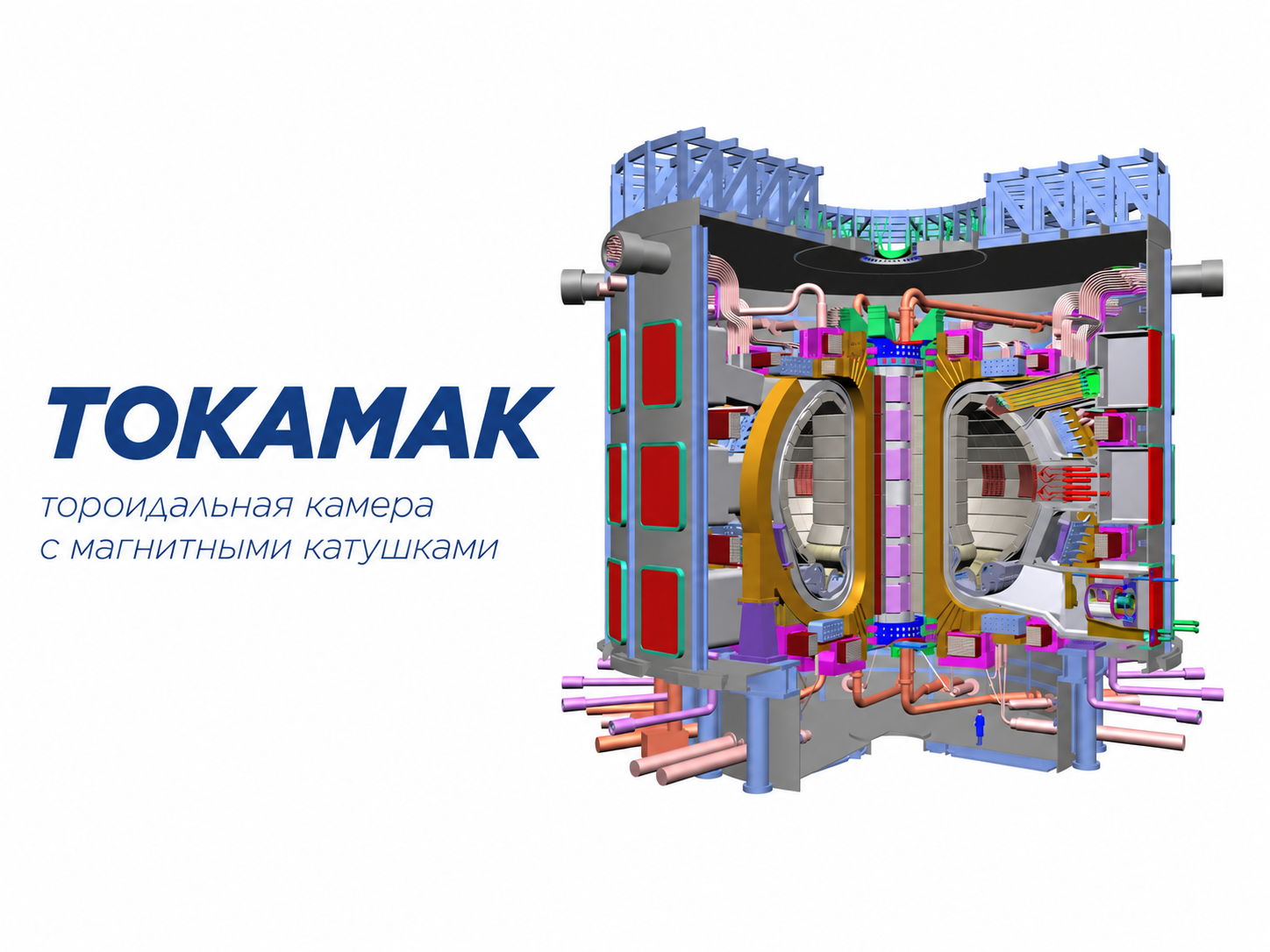
One of the most striking examples of the use of nuclear energy for peaceful purposes and the CIS states effective cooperation in the field of plasma physics research and controlled thermonuclear fusion technologies — as an innovative direction for future energy production — is the Kazakhstan project involving the KTM material science tokamak.
The KTM is the world’s first specialized tokamak designed primarily for testing materials and components for future thermonuclear reactors, including the International Experimental Thermonuclear Reactor (ITER).
The idea of the KTM creation was initiated by the Russian academician Yevgeny Velikhov in 1998. The initiative was supported by the First President of Kazakhstan Nursultan Nazarbayev. The facility was built at the National Nuclear Center in the town of Kurchatov (Abay Region, Republic of Kazakhstan) with the leading participation of Russian specialists. Currently, the Rosatom State Corporation acts as the Russia’s participation coordinator in the project.
In May 2017, six CIS countries — Belarus, Armenia, Kazakhstan, Kyrgyzstan, Russia, and Tajikistan — signed an Agreement on the Joint Use of the Experimental Complex Based on Kazakhstan’s Material Science Tokamak.
The Commonwealth involvement in the project makes it possible to distribute the workload and combine expertise. At the same time, the joint program enables scientists from different countries to exchange knowledge, samples, equipment, publish joint results, and move quicker towards common goals.
The CIS participation helps strengthen the project’s position in the international scientific community: This is not just a national initiative, but a platform for the multilateral dialogue and joint efforts in the thermonuclear energy development.
Currently, the fourth Programme of Scientific Research at the Kazakhstani Material Tokamak (for 2027–2029) is being developed. The previous three programmes were successfully implemented, which enabled the participating countries to improve their specialists qualifications, provide students and young scientists with real experience working at a cutting edge facility, and strengthen the scientific infrastructure.
As a result, the involvement of CIS countries transformed KTM from a purely national initiative into an effective international laboratory, where science advances faster thanks to synergy and joint efforts.
All the information provided via the links is in Russian.