











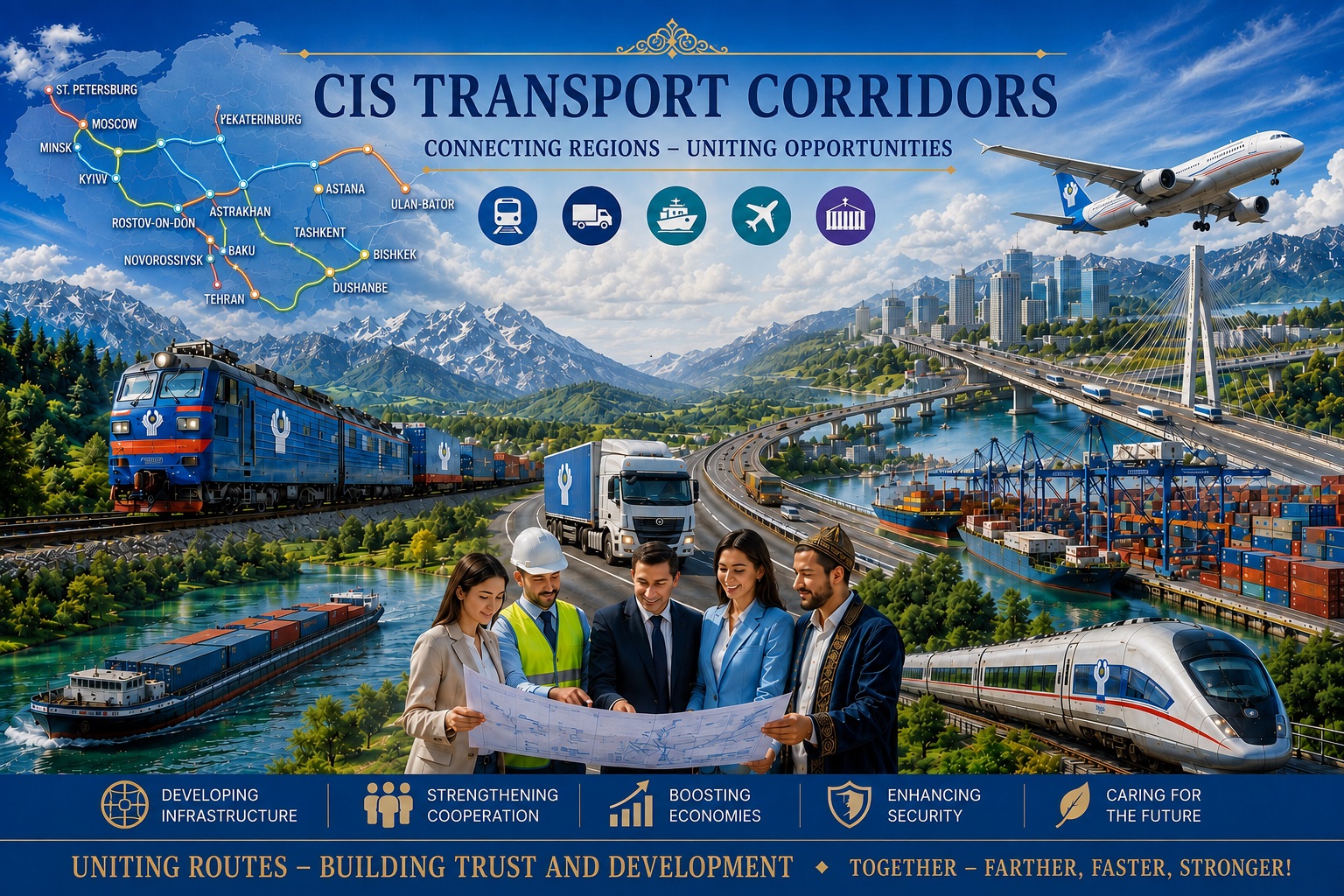
In May 2026, the Council of Heads of Government of the Commonwealth of Independent States approved the Concept for the Integration of Main Transport Arteries Passing through the Territories of the CIS Member States.
As the text of the document indicates, its adoption was a response to the significant increase in transportation volumes through the CIS region along major transport corridors, driven in part by the global economy’s need for fast and efficient delivery of goods.
The CIS member states’ coordinated approaches to the development of transport and logistics infrastructure and international transport corridors are also reflected in a number of other strategic documents adopted over the past five years:
The CIS Economic Development Strategy through 2030 (in Russian),
Priority Areas of Cooperation between the CIS Member States in Transport through 2030 (in Russian),
The Concept for the Strategic Development of Rail Transport in the 1520 Area through 2030 (in Russian).
Action Plan for Infrastructure Optimization and Development of International Transport Corridors Passing through the Territories of the CIS Member States for the period up to 2030 (in Russian).
Digitalization Strategies for the Main Multimodal Transport Corridors of the CIS Member States (in Russian).
Monitoring the efficiency of transport and logistics infrastructure and international transport corridors (ITCs) demonstrates the implementation of systematic, targeted work to develop and improve the network of regional and transit routes providing access to global markets, and the facilities located along them.
Further work on developing the CIS transport complex includes:
developing coordinated transport and logistics schemes for cargo delivery along ITC routes;
developing and coordinating key integration areas and junction points with the North-South, Europe-Western China, Belt and Road, Northern Sea Route, Trans-Siberian Railway, and Baikal-Amur Mainline (BAM) ITCs to ensure seamless and transit transportation;
Developing a network of transport and logistics centers, optimizing the connections between rail, road, and water sections of the ITC;
Improving the organization of transit along ITC routes, including through the use of multimodal transport, in terms of organizing freight forwarding activities and providing logistics services;
Developing transport technologies and digitalizing technological processes (creating a digital environment for interaction between transportation participants on the ITC);
Involving the business community in joint (intra- and extra-regional) investment mechanisms in the development of key ITC infrastructure facilities for the purpose of modernizing them, technically equipping them, and constructing primary and auxiliary infrastructure elements.
Resolving these issues will significantly enhance the competitiveness of regional transport in CIS member states, attract additional volumes of foreign trade cargo, create modern transport links, reduce transit costs, and improve the quality and accessibility of transport services.

48th meeting of the Council on Aviation and Use of CIS Airspace.
Dushanbe, April 9, 2026.
Further development of transport and logistics infrastructure and the International Transport Corridor (ITC) will facilitate the creation of conditions for the efficient transportation and transit of goods between CIS member states, including by ensuring that these operations are carried out on the basis of international agreements and arrangements, as well as the development of international transit across the Eurasian continent as a whole.
CIS Secretary-General Sergey Lebedev highlighted the creation of an integrated transport network within the Commonwealth as one of the near-term economic objectives. He stated that its implementation will ensure safe, fast, and efficient freight transport between states and reduce transport costs, increasing the transit potential of member countries.
The increased attention paid to transport by Turkmenistan, the country holding the CIS presidency in 2026, also demonstrates the strategic nature of this objective. In particular, Ashgabat estimates that the implementation of the “Integration of CIS Transport Corridors” initiative, which involves coordinating transport route plans, developing multimodal transportation, digitalizing transit procedures, and declaring one of the upcoming thematic years the Year of Transport Connectivity of the Commonwealth, will facilitate the full development of the CIS countries’ existing logistics and infrastructure potential.